Unit 9: Birthdays
Can-Do Goal
I can understand and use everyday English to talk about birthdays.
I can talk about birthday celebrations, friends, decorations, and actions. I can also use prefixes, suffixes, and adverbs in simple sentences.
Birthday Vocabulary
Important Words
- birthday = the day a person was born
- celebration = a special event for happiness
- friends = people you like and spend time with
- decorate = to make a place look nice
- garage = a building where a car is kept
- eventful = full of many interesting things
- prefix = letters added to the beginning of a word
- suffix = letters added to the end of a word
- adverbs = words that tell how an action happens
- carefully = in a careful way
- happily = in a happy way
- swiftly = quickly
- peacefully = in a calm way
- extremely = very, very much
Grammar 1: Prefixes and Suffixes
What is a Prefix?
A prefix goes at the beginning of a word. It can change the meaning.
Examples:
- happy → unhappy (not happy)
- kind → unkind (not kind)
- possible → impossible (not possible)
What is a Suffix?
A suffix goes at the end of a word. It can change the word form or meaning.
Examples:
- event → eventful
- careful → carefully
- happy → happily
Worked Example 1
Word: happy
Add the suffix -ly.
happy → happily
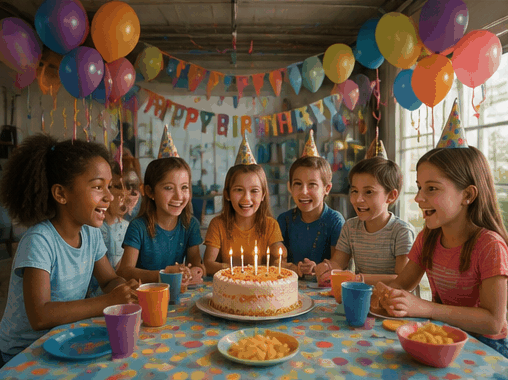
Sentence: The children sang happily at the birthday party.
Worked Example 2
Word: event
Add the suffix -ful.
event → eventful
Sentence: It was an eventful birthday celebration.
🔑 Đáp án & Giải thích
Prefix được thêm vào đầu từ để đổi nghĩa. Ví dụ: happy → unhappy.
Suffix được thêm vào cuối từ để đổi loại từ hoặc nghĩa. Ví dụ: happy → happily, event → eventful.
Đuôi -ly thường biến tính từ thành trạng từ.
Grammar 2: Using Adverbs to Modify Verbs
What is an Adverb?
An adverb tells us how an action happens.
It usually answers the question: How?
Examples
- She decorated the room carefully.
- The children laughed happily.
- He ran swiftly to the party.
- The baby slept peacefully.
Using "Extremely"
Extremely is an adverb. It makes another word stronger.
- The party was extremely fun.
- She was extremely happy.
Worked Example 3
Verb: decorate
Question: How did they decorate the room?
Answer: They decorated the room carefully.
The adverb carefully tells how they decorated.
🔑 Đáp án & Giải thích
Trạng từ (adverb) bổ nghĩa cho động từ.
Ví dụ: decorate carefully, laugh happily, run swiftly, sleep peacefully.
Extremely thường bổ nghĩa cho tính từ hoặc trạng từ khác để nhấn mạnh mức độ.
Useful Birthday Sentences
- Today is my birthday.
- We are having a celebration.
- My friends are coming to the party.
- We decorate the room with balloons.
- The party is in the garage.
- Everyone is happily singing.
- It is an eventful day.
- The children carefully open their gifts.
Remember!
- A prefix comes before a word.
- A suffix comes after a word.
- Many adverbs end in -ly.
- Adverbs tell us how an action happens.
- Use birthday vocabulary to talk about parties and celebrations.