Unit 10: Holidays
What Will You Learn?
Can-do: Understand and use everyday English to talk about holidays.
In this unit, you will learn:
- Holiday vocabulary
- Adverbs
- How to use dialogue in narrative writing
- How to write about holiday activities and celebrations
Vocabulary: Holidays
Important Words
- Holidays – special days for celebration or rest.
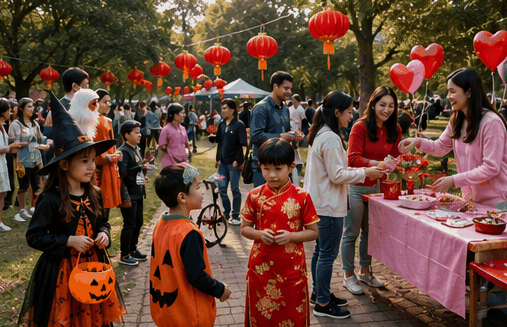
- Halloween – a holiday on October 31. People wear costumes and collect candy.
- Hanukkah – a Jewish holiday with lights and family celebrations.
- Chinese New Year – a holiday that celebrates the beginning of a new lunar year.
- Valentine’s Day – a holiday on February 14. People show love and friendship.
- quietly – in a calm way with little noise.
- peacefully – in a calm and relaxed way.
- happily – in a happy way.
- cheerfully – in a joyful and positive way.
Grammar 1: Adverbs
What Is an Adverb?
An adverb tells us how someone does an action.
Many adverbs end in -ly.
| Adverb | Meaning |
|---|---|
| quietly | with little noise |
| peacefully | in a calm way |
| happily | with happiness |
| cheerfully | with joy |
The children celebrated Chinese New Year happily.
The family sat together peacefully.
The students listened quietly.
🔑 Đáp án & Giải thích
Trạng từ (adverb) cho biết hành động được thực hiện như thế nào.
- quietly = một cách yên lặng
- peacefully = một cách bình yên
- happily = một cách vui vẻ
- cheerfully = một cách hồ hởi, vui tươi
Trạng từ thường đứng sau động từ hoặc sau tân ngữ.
Grammar 2: Dialogue in Narrative Writing
What Is Dialogue?
Dialogue is the words that people say in a story.
Use quotation marks (" ") around the spoken words.
Pattern:
"Spoken words," said the person.
"Happy Valentine's Day!" said Mia.
"I like the lanterns," said Ben during Chinese New Year.
"Let's get candy!" shouted the children on Halloween.
Dialogue + Narrative
A story can have both narration and dialogue.
Narration: It was Halloween night.
Dialogue: "Look at my costume!" said Emma cheerfully.
🔑 Đáp án & Giải thích
Dialogue là lời nhân vật nói trong câu chuyện.
Dùng dấu ngoặc kép " " để bao quanh lời nói.
Ví dụ:
"Happy Valentine's Day!" said Mia.
Khi viết truyện, có thể kết hợp:
- Narrative (phần kể chuyện)
- Dialogue (lời nhân vật nói)
Worked Examples
Worked Example 1
Sentence: The children smiled happily.
Question: Which word is the adverb?
Answer: happily
Why? It tells us how the children smiled.
Worked Example 2
Sentence: "Happy Hanukkah!" said Dad.
Question: What is the dialogue?
Answer: "Happy Hanukkah!"
Why? These are the exact words spoken by Dad.
Worked Example 3
Story:
It was Chinese New Year. "Look at the dragon!" said Leo cheerfully.
Find:
- Dialogue → "Look at the dragon!"
- Adverb → cheerfully
Quick Review
- Holidays are special days for celebrations.
- Halloween, Hanukkah, Chinese New Year, and Valentine’s Day are holidays.
- Adverbs tell how an action happens.
- Common adverbs: quietly, peacefully, happily, cheerfully.
- Dialogue shows what people say in a story.
- Use quotation marks around dialogue.