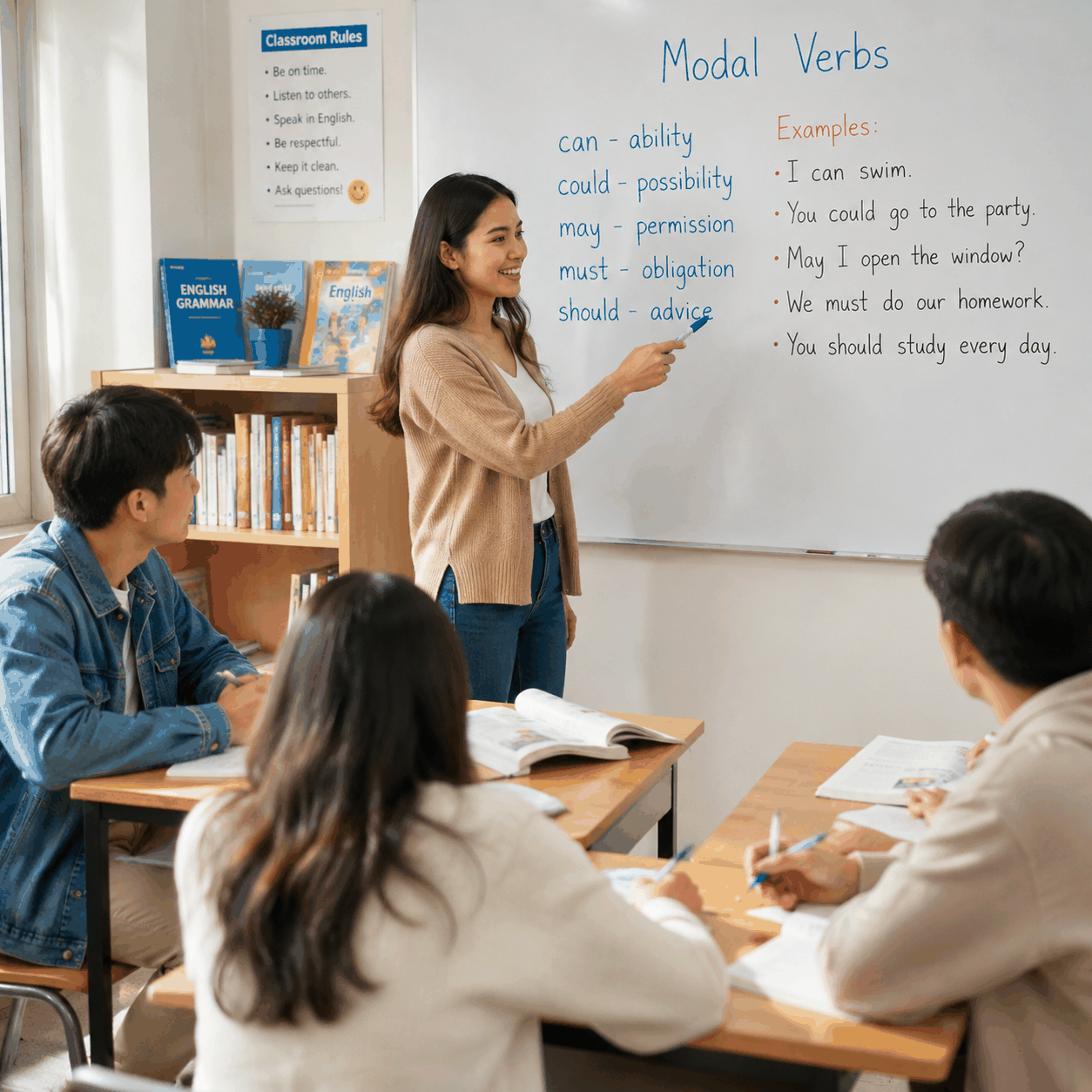
Unit 5: Modal Verbs
Target Vocabulary
Prefixes
Words can start with prefixes to change their meaning. Examples: anti- (against), bi- (two), pre- (before), re- (again).
Word Formation: Nouns
Nouns can be made from people, verbs, or adjectives.
- People: -er, -ist, -ant, -ian, -ee → teacher, artist, assistant, musician, employee
- From verbs: -ment, -ion, -ance, -ation → development, creation, performance
- From adjectives: -ness, -ity, -cy → happiness, activity, privacy
Phrasal Verbs with "Get"
Examples:
- get along with (be friendly with)
- get over (recover from)
- get round to (find time for)
Prepositions
Common prepositions with verbs and nouns:
- look after, look at, join in
- impression on, keen on, need for
- increase in, laugh at, notice of
Modal Verbs
Ability
Can / Could / Be able to describe what someone can do:
- Present: I can swim.
- Past: She could run fast.
- Future: They will be able to come tomorrow.
Obligation / Necessity
Use must, have to, should, ought for duties:
- You must wear a seatbelt.
- We have to finish work today.
- He should eat healthy food.
Absence of Necessity & Prohibition
To show something is not necessary: needn’t, don’t have to. For prohibition: mustn’t, can’t.
- You don’t have to come early.
- You mustn’t smoke here.
Possibility, Probability & Assumptions
Modal verbs can express chance or certainty:
- Possibility: She might be late.
- Probability: He should know the answer.
- Logical assumption: It must be cold outside.
Permission, Requests, Offers, Suggestions, Advice
- Permission: Can, May → Can I open the window?
- Requests: Could, Would → Could you help me?
- Offers: Shall, Can → Shall I carry that for you?
- Suggestions: Why don’t we, How about → How about going out?
- Advice: Should, Ought → You should drink water.
Expressions Similar to Modals
Be supposed to, Be likely to → similar meanings to modals for duties or probability.
- You are supposed to finish homework today.
- It is likely to rain this evening.