Unit 2: Daily Life and Routines
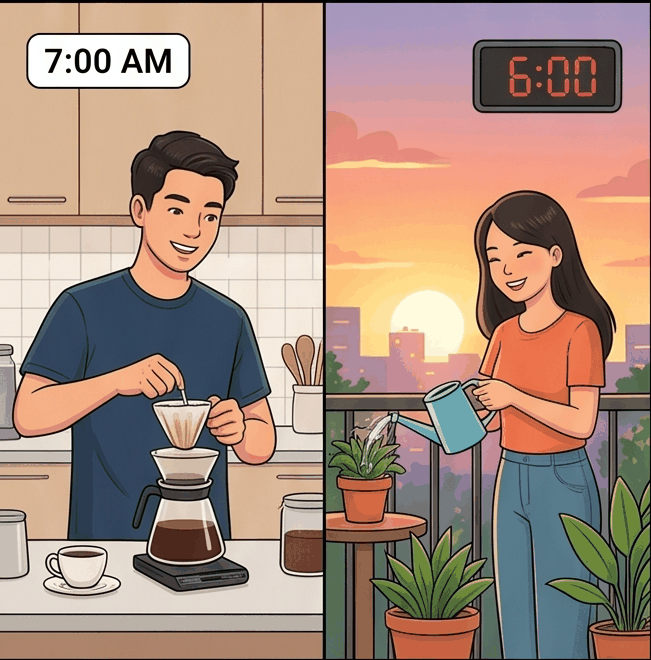
In this unit, you will learn how to describe your typical day and ask your friends about their morning and evening routines.
Trong bài học này, bạn sẽ học cách mô tả một ngày bình thường của mình và hỏi bạn bè về các thói quen quen thuộc vào buổi sáng và buổi tối.
Can-do Statement
I can talk about my daily activities and ask others about theirs.
In this unit, you learn how to:
- Talk about your day
- Say what you do in the morning, afternoon, and evening
- Use simple verbs for daily activities
- Ask questions about routines
- Give simple instructions
Target Vocabulary
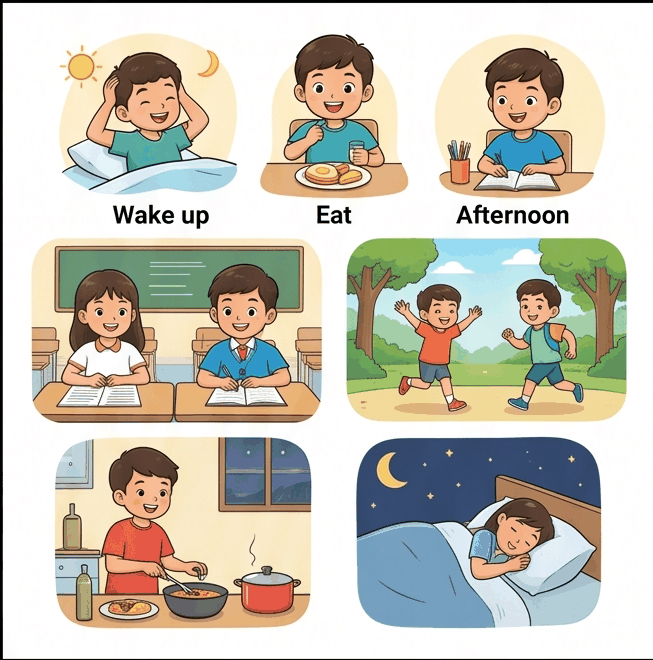
Daily Life Words
| Word | Meaning | Example |
|---|---|---|
| day | 24 hours | I have a busy day. |
| morning | the early part of the day | I study in the morning. |
| afternoon | the middle part of the day | We work in the afternoon. |
| evening | the late part of the day | I cook dinner in the evening. |
| eat | to have food | I eat breakfast at 7:00. |
| drink | to have water, tea, coffee, etc. | She drinks tea every day. |
| work | to do a job | My father works in an office. |
| study | to learn | They study English. |
| go | to move to another place | I go to school by bus. |
| come | to move here | Please come to my house. |
| sleep | to rest at night | I sleep at 10:00 p.m. |
| wake up | to stop sleeping | He wakes up at 6:00. |
| cook | to make food | My mother cooks dinner. |
| exercise | to do sports or physical activity | We exercise in the park. |
| play | to do games or sports | The children play football. |
Grammar 1: Present Simple
What is the Present Simple?
We use the present simple to talk about:
- daily routines
- habits
- things we do every day
Sentence Form
Subject + verb
I study English.
They work every day.
She plays tennis.
Important Rule
With he / she / it, add -s to the verb.
He works.
She cooks.
It sleeps.
Questions
Use Do or Does.
Do you exercise every day?
Does she study at night?
🔑 Đáp án & Giải thích
Thì hiện tại đơn dùng để nói về thói quen và hoạt động hằng ngày.
Cấu trúc:
- I/You/We/They + động từ
- He/She/It + động từ thêm s/es
Ví dụ:
- She works every day.
- He wakes up at 6:00.
Câu hỏi:
- Do you study English?
- Does she cook dinner?
Grammar 2: Adverbs of Frequency
What are Adverbs of Frequency?
These words tell us how often we do something.
| Word | Meaning |
|---|---|
| always | 100% of the time |
| usually | many times |
| sometimes | not every time |
Position in a Sentence
Put the adverb before the main verb.
I always wake up early.
She usually drinks coffee.
They sometimes play football.
🔑 Đáp án & Giải thích
Trạng từ tần suất cho biết mức độ thường xuyên.
- always = luôn luôn
- usually = thường thường
- sometimes = thỉnh thoảng
Trạng từ thường đứng trước động từ chính.
Ví dụ:
- I always study at night.
- She usually cooks dinner.
Grammar 3: Imperatives for Instructions
What is an Imperative?
We use imperatives to:
- give instructions
- tell someone what to do
Form
Use the verb only.
Wake up early.
Drink water.
Exercise every day.
Negative Imperatives
Use Don't + verb.
Don't sleep late.
Don't skip breakfast.
🔑 Đáp án & Giải thích
Câu mệnh lệnh dùng để đưa ra hướng dẫn hoặc yêu cầu.
Cấu trúc:
- Verb + ...
- Don't + verb + ...
Ví dụ:
- Eat breakfast.
- Exercise every day.
- Don't sleep late.
Worked Examples
Worked Example 1
Question: Talk about Anna's routine.
Anna wakes up at 6:30. She studies in the morning. She exercises in the evening.
Answer:
Anna wakes up at 6:30.
She studies in the morning.
She exercises in the evening.
Why? We use the present simple because this is Anna's daily routine.
Worked Example 2
Question: Add an adverb of frequency.
I _____ drink coffee in the morning. (always)
Answer:
I always drink coffee in the morning.
Why? The adverb goes before the main verb.
Worked Example 3
Question: Make an imperative sentence.
(exercise / every day)
Answer:
Exercise every day.
Why? Imperatives use the base verb only.
Useful Questions and Answers
Talking About Daily Life
Q: What do you do in the morning?
A: I study English and drink coffee.
Q: Do you exercise every day?
A: Yes, I do.
Q: What time do you sleep?
A: I sleep at 10:00 p.m.
Unit Summary
- Use the present simple for routines and habits.
- Use always, usually, sometimes to talk about frequency.
- Use imperatives for instructions.
- Use daily activity words to describe your day.
Now you can talk about your daily routines in English!