Unit 5: Talking About Time and Schedules

In this unit, you will learn how to talk about days, times, and schedules for your science projects and lab work. You will practice asking when a meeting starts and telling others your project deadlines.
Trong bài học này, bạn sẽ học cách thảo luận về ngày, giờ và lịch trình cho các dự án khoa học hoặc công việc phòng thí nghiệm. Bạn sẽ thực hành cách hỏi thời gian bắt đầu cuộc họp và thông báo về hạn chót của dự án.
Unit Goal
Can-do statement: I can talk about days, times, and schedules for science activities or engineering projects.
In this unit, you will learn words for time, talk about daily routines, discuss project schedules, and say what you can do.
Key Vocabulary
| Word | Simple Meaning | Example |
|---|---|---|
| day | 24 hours | Today is a busy day. |
| week | Seven days | The project takes one week. |
| morning | The early part of the day | I study in the morning. |
| afternoon | The middle part of the day | We have a meeting in the afternoon. |
| evening | The later part of the day | I finish work in the evening. |
| today | This day | We start the test today. |
| tomorrow | The next day | The meeting is tomorrow. |
| yesterday | The day before today | We finished the report yesterday. |
| plan | An idea of what to do | Our plan is ready. |
| meeting | A time when people talk together | The meeting starts at 9:00. |
| appointment | A planned time to meet someone | I have an appointment at 2:00. |
| start | Begin | We start work at 8:00. |
| finish | End | We finish the project on Friday. |
| work | Do a job | Engineers work on projects. |
| study | Learn something | Students study science. |
Time and Schedules in Science & Engineering
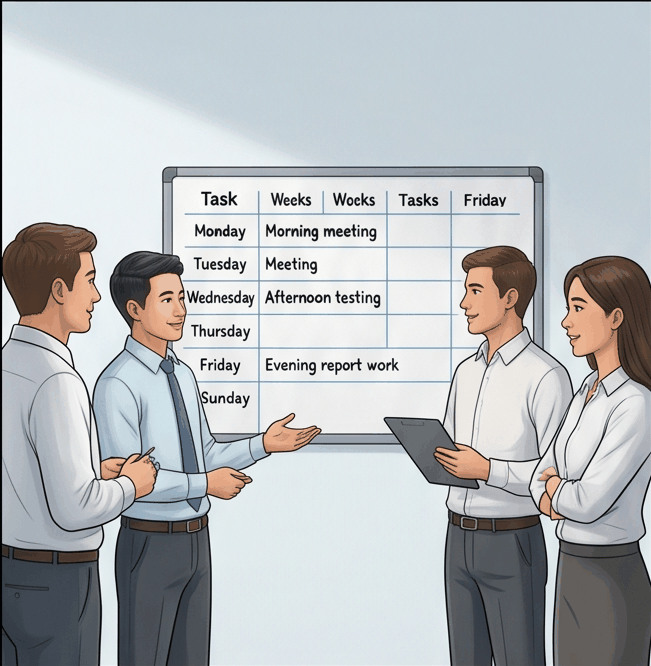
Science and engineering projects often have schedules.
- Start a test on Monday.
- Have a meeting in the morning.
- Finish a report on Friday.
- Study project results in the afternoon.
Grammar 1: Present Simple for Routines
Use
We use the present simple for routines, habits, and regular schedules.
Pattern:
Subject + base verb
Examples:
- I study every morning.
- We start work at 8:00.
- They finish at 5:00.
Remember
With he / she / it, add -s to the verb.
- She studies in the laboratory.
- He starts work at 9:00.
- It finishes at 4:00.
Grammar 2: Time Expressions
Common Time Expressions
| Expression | Example |
|---|---|
| today | We have a meeting today. |
| tomorrow | The test starts tomorrow. |
| yesterday | We finished the work yesterday. |
| in the morning | I study in the morning. |
| in the afternoon | We have a meeting in the afternoon. |
| in the evening | I finish work in the evening. |
Grammar 3: Can for Ability
Use
Use can to talk about ability.
Pattern:
Subject + can + verb
Examples:
- I can study science.
- We can plan the project.
- She can finish the report today.
Negative Form
Subject + cannot (can't) + verb
- I can't finish today.
- We can't start the test now.
Worked Example 1
Situation: Anna studies engineering every morning.
Question: Which tense do we use?
Answer: Present simple.
Sentence: Anna studies engineering every morning.
Why? It is a regular routine.
🔑 Đáp án & Giải thích
Đây là thói quen lặp lại thường xuyên nên dùng thì hiện tại đơn. Chủ ngữ "Anna" là ngôi thứ ba số ít nên động từ "study" đổi thành "studies".Worked Example 2
Situation: The team has a meeting tomorrow.
Question: What time expression is used?
Answer: Tomorrow.
Sentence: The team has a meeting tomorrow.
Why? "Tomorrow" means the next day.
🔑 Đáp án & Giải thích
Từ "tomorrow" là trạng từ thời gian chỉ ngày mai. Nó giúp người nghe biết thời điểm diễn ra cuộc họp.Worked Example 3
Situation: A student is able to plan a project.
Question: How can we say this?
Answer: The student can plan a project.
Why? We use "can" for ability.
🔑 Đáp án & Giải thích
Động từ khuyết thiếu "can" dùng để diễn tả khả năng hoặc năng lực làm việc gì đó. Sau "can" luôn dùng động từ nguyên mẫu không chia.Quick Summary
- Use vocabulary for days, times, and schedules.
- Use the present simple for routines.
- Use time expressions such as today, tomorrow, and yesterday.
- Use can to talk about ability.
- Talk about science activities and engineering project schedules.