Unit 4: Comparing Data and Results
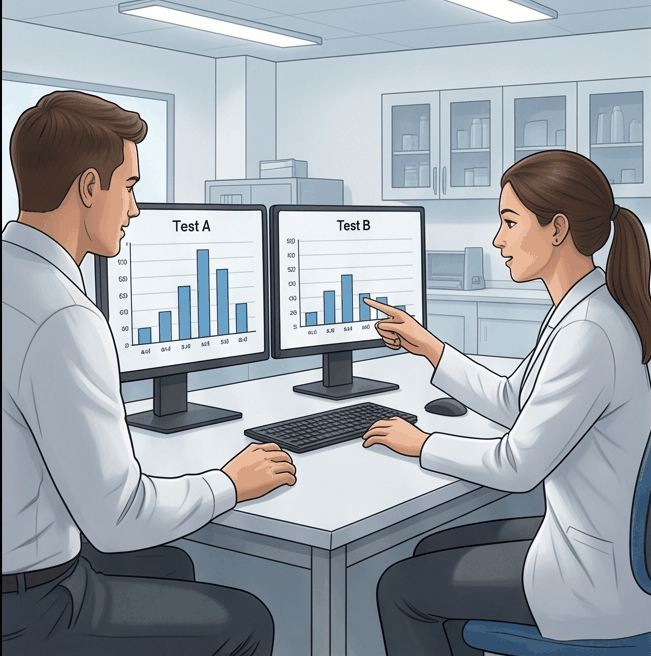
In this unit, you will learn simple words to compare data and results. You will practice talking about what is bigger, smaller, or the same in your work.
Trong bài học này, bạn sẽ học các từ vựng đơn giản để so sánh số liệu và kết quả. Bạn sẽ thực hành cách nói về những điểm lớn hơn, nhỏ hơn hoặc giống nhau trong công việc của mình.
Can-do Statement
I can compare numbers, results, or information and talk about differences and similarities.
In science and engineering, we often compare data. We look at numbers, graphs, charts, and results. We can say which thing is bigger, smaller, higher, lower, the same, or different.
Vocabulary
| Word | Simple Meaning | Example |
|---|---|---|
| big | large in size | The machine is big. |
| small | not big | The box is small. |
| high | at a large level or number | The temperature is high. |
| low | not high | The pressure is low. |
| more | a larger amount | Sample A has more water. |
| less | a smaller amount | Sample B has less water. |
| same | not different | The results are the same. |
| different | not the same | The two graphs are different. |
| number | a value such as 5, 20, or 100 | The number is 25. |
| result | the answer after a test or experiment | The result is good. |
| example | something that shows an idea | Here is an example. |
| graph | a picture that shows data | The graph shows temperature. |
| chart | a table or picture of information | The chart shows results. |
| data | information or numbers | The data are useful. |
| problem | something that needs a solution | We solve the problem. |
Understanding Data and Results
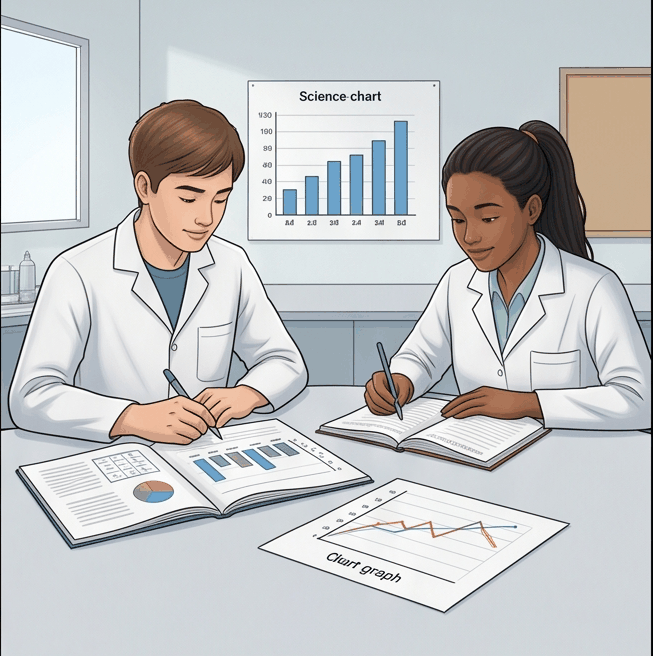
We compare data to understand information.
- Which number is higher?
- Which result is better?
- Are the results the same?
- Are the graphs different?
These questions help us understand data clearly.
Grammar 1: Comparatives (bigger, smaller)
What are comparatives?
We use comparatives to compare two things.
| Adjective | Comparative |
|---|---|
| big | bigger |
| small | smaller |
| high | higher |
| low | lower |
Pattern:
Thing A + is + comparative + than + Thing B
Examples:
- The number 20 is higher than 10.
- Graph A is bigger than Graph B.
- Result B is better than Result A.
Grammar 2: Present Simple for Facts
Use present simple for facts and data.
Pattern:
Subject + verb
Examples:
- The chart shows the data.
- The graph shows temperature.
- Water boils at 100°C.
- The result is correct.
We use present simple when information is true or when we describe data.
Grammar 3: There is / There are
Use there is and there are to talk about what exists.
| Form | Example |
|---|---|
| There is + singular noun | There is one graph. |
| There are + plural noun | There are two charts. |
Examples:
- There is a problem.
- There is one result.
- There are three examples.
- There are many numbers in the chart.
Worked Example 1
Data:
- Graph A = 40
- Graph B = 60
Question: Which graph is higher?
Answer: Graph B is higher than Graph A.
Why? 60 is greater than 40.
🔑 Đáp án & Giải thích
Ta dùng dạng so sánh hơn: higher than.
Vì 60 lớn hơn 40 nên Graph B cao hơn Graph A.
Worked Example 2
Data:
- Result A = 25
- Result B = 25
Question: Are the results different?
Answer: No. The results are the same.
Why? Both numbers are 25.
🔑 Đáp án & Giải thích
Hai kết quả đều bằng 25 nên không khác nhau.
Ta dùng cấu trúc: The results are the same.
Worked Example 3
Situation:
A report contains one graph and three charts.
Question: Use there is / there are.
Answer:
- There is one graph.
- There are three charts.
Why? One graph = singular. Three charts = plural.
🔑 Đáp án & Giải thích
Dùng There is với danh từ số ít.
Dùng There are với danh từ số nhiều.
One graph → There is.
Three charts → There are.
Unit Summary
- Use bigger, smaller, higher, lower to compare two things.
- Use present simple for facts and data descriptions.
- Use there is for one thing and there are for more than one thing.
- Use words like same, different, more, and less when discussing results.
- Graphs, charts, and data help us compare information.