Unit 3: Meals and Family Eating
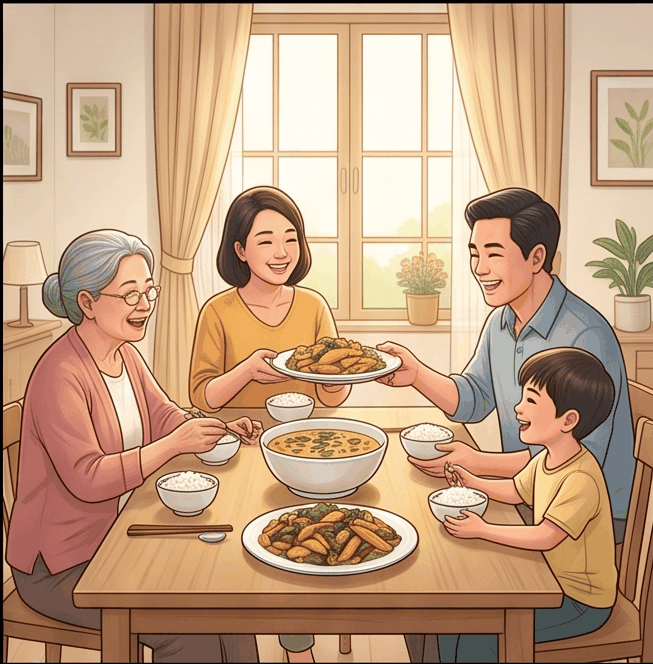
In this unit, you will learn simple words to describe your daily meals. You will practice talking about what you and your family love to eat together.
Trong bài học này, bạn sẽ học các từ vựng đơn giản để miêu tả các bữa ăn hàng ngày. Bạn sẽ thực hành nói về những món ăn mà bạn và gia đình yêu thích cùng nhau.
Unit Goal
Can-do statement: I can describe meals and talk about what my family eats.
In this unit, you will learn words for meals, family eating habits, and simple grammar to talk about everyday food routines.
Meal Time Vocabulary
| Word | Simple Meaning | Example |
|---|---|---|
| breakfast | The first meal in the morning | I eat breakfast at 7:00. |
| lunch | A meal in the middle of the day | We have lunch at school. |
| dinner | The main meal in the evening | My family eats dinner together. |
| snack | A small amount of food between meals | I have a snack at 4:00. |
| meal | A time when you eat food | Dinner is my favorite meal. |
| family | Your parents, children, and relatives | My family is large. |
| together | With other people | We eat together every night. |
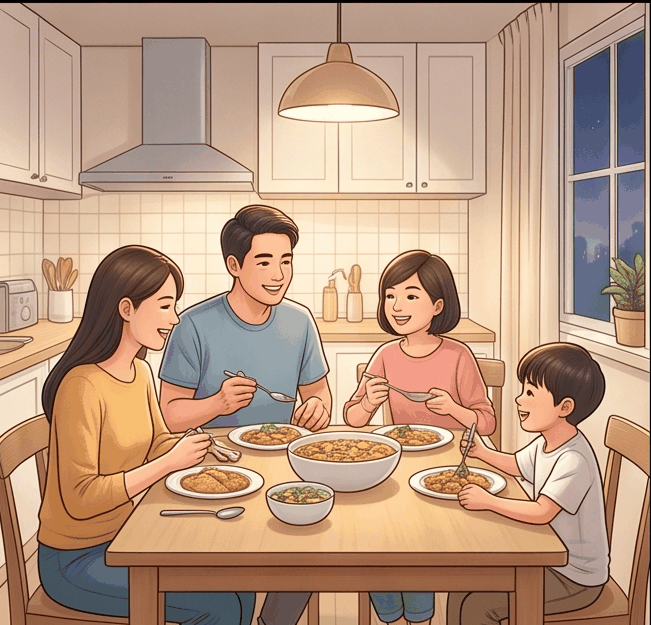
Kitchen and Eating Vocabulary
| Word | Simple Meaning | Example |
|---|---|---|
| plate | A flat dish for food | The rice is on the plate. |
| knife | A tool for cutting food | Use the knife carefully. |
| fork | A tool with points for eating | I eat pasta with a fork. |
| spoon | A tool for soup or rice | She uses a spoon. |
| dish | A prepared food or a plate for food | This dish is very tasty. |
| healthy | Good for your body | Fruit is healthy. |
| tasty | Having a good flavor | The soup is tasty. |
| hungry | Wanting food | I am hungry after school. |
Grammar 1: Present Simple for Habits
Use
We use the present simple to talk about things we do every day or often.
Structure:
Subject + verb
- I eat breakfast at 7:00.
- We have dinner together.
- They eat healthy food.
For he / she / it: add -s to the verb.
- She eats lunch at school.
- He has a snack after work.
Worked Example 1
Question: What does Anna do every morning?
Information: Anna eats eggs every morning.
Answer: Anna eats eggs every morning.
Because Anna = she, we add -s to the verb.
Grammar 2: Have Got
Use
We use have got to talk about possession.
| Subject | Form |
|---|---|
| I / You / We / They | have got |
| He / She / It | has got |
Examples:
- I have got a spoon.
- We have got a large table.
- She has got a new plate.
- My family has got healthy food at home.
Worked Example 2
Question: Tom has a fork.
Answer: Tom has got a fork.
Tom = he, so we use has got.
Grammar 3: This / That
Use
- This = something near you.
- That = something farther away.
| Word | Meaning | Example |
|---|---|---|
| This | Near | This spoon is clean. |
| That | Far | That dish looks tasty. |
Worked Example 3
Situation: The plate is in your hand.
Answer: This plate is clean.
Situation: The plate is on a table across the room.
Answer: That plate is clean.
Useful Sentences
- I eat breakfast at 7 o'clock.
- My family eats dinner together.
- We have got four plates.
- This dish is tasty.
- That fork is clean.
- I am hungry after school.
- We usually have a healthy meal.
Quick Summary
- Breakfast, lunch, dinner, and snacks are different meals.
- Use the present simple for everyday habits.
- Use have got and has got for possession.
- Use this for things near you and that for things farther away.
- Use vocabulary about family meals and eating tools to talk about daily life.
🔑 Đáp án & Giải thích
Ví dụ 1: "Anna eats eggs every morning." Vì Anna tương đương với "she", động từ trong hiện tại đơn thêm -s → eats.
Ví dụ 2: "Tom has got a fork." Vì Tom tương đương với "he", dùng has got thay vì have got.
Ví dụ 3: Dùng this khi đồ vật ở gần người nói. Dùng that khi đồ vật ở xa người nói.
Ghi nhớ:
- Hiện tại đơn diễn tả thói quen hằng ngày.
- have got / has got = có, sở hữu.
- this = này (gần), that = kia (xa).