Unit 1: My Day
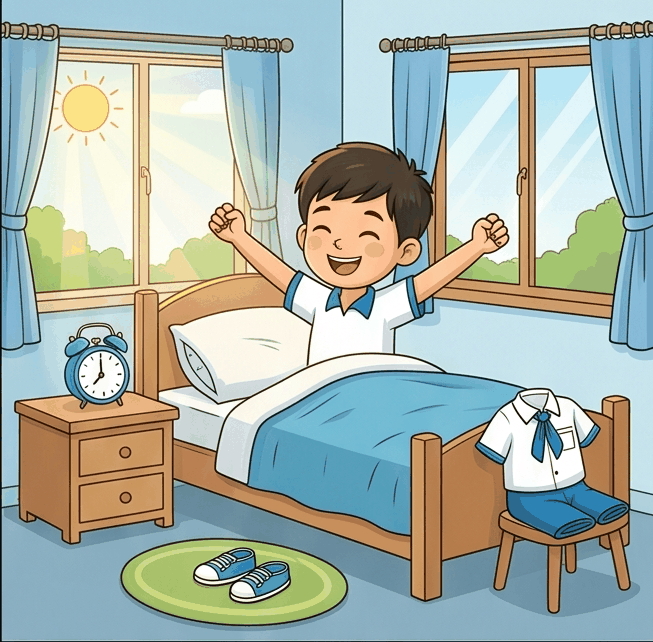
In this unit, you will learn how to talk about your daily routine. You will practice asking and answering questions about what you do from morning to night.
Trong bài học này, con sẽ học cách chia sẻ về các hoạt động hằng ngày của mình. Con sẽ được thực hành cách hỏi và trả lời về những việc mình làm từ sáng đến tối.
1. Vocabulary: Daily Routine
day: the 24 hours from morning to night
morning: the time from when you wake up until noon
afternoon: the time after noon until evening
night: the time when it is dark and you sleep
wake: to stop sleeping
eat: to have food
play: to have fun or do games
school: the place to learn
home: where you live
friend: a person you like
book: something you read
toy: something to play with
run: to move fast with your legs
sleep: to rest at night
2. Grammar: Present Simple & Daily Activities
2.1 Present Simple
We use the present simple to talk about daily routines and habits.
- I wake up at 7:00.
- She plays with her friend.
- They eat lunch at 12:00.
2.2 To Be
The verb to be is used to describe people, places, or times.
- I am at school.
- He is happy in the morning.
- We are friends.
2.3 Have Got
We use have got to talk about possessions or things we have.
- I have got a book.
- She has got a toy.
- They have got a big home.
3. Worked Examples
Example 1: Describe your morning routine.
Answer: I wake up at 7:00. I eat breakfast. I go to school.
Example 2: Talk about your friends.
Answer: My friend is happy. We play with a toy. She has got a book.
Example 3: Daily evening routine.
Answer: I come home. I eat dinner. I sleep at 9:00.
🔑 Đáp án & Giải thích
Ví dụ 1: Dùng động từ present simple cho thói quen hàng ngày.
Ví dụ 2: Dùng "to be" để mô tả cảm xúc, "play" cho hoạt động, "have got" cho sở hữu.
Ví dụ 3: Dùng động từ present simple cho hoạt động buổi tối hàng ngày.