180 Days of High-Frequency Words (A1)
Unit 7
Unit Goal
Vocabulary: People and Things
| Word | Simple Meaning | Example |
|---|---|---|
| someone | a person | Someone is at the door. |
| me | the speaker | Please help me. |
| thing | an object or idea | This thing is useful. |
| something | an unknown thing | I want something to eat. |
| some | a small amount or number | I have some apples. |
| group | many people together | The group is happy. |
| paper | material for writing | Write on the paper. |
| cloth | material used for clothes | The cloth is soft. |
| net | a mesh used to catch things | The fish is in the net. |
| nest | a bird's home | The bird sits in its nest. |
Vocabulary: Actions
| Word | Simple Meaning | Example |
|---|---|---|
| see | look at with your eyes | I can see a dog. |
| seen | past form used with have/has | I have seen that movie. |
| open | not closed; make something open | Open the window. |
| close | shut something | Please close the door. |
| closed | not open | The store is closed. |
| begin | start | We begin class at 8. |
| lose | not keep or not win | Do not lose your bag. |
| run | move fast on your feet | The boy can run fast. |
| mix | put things together | Mix the colors. |
| got | received or had | I got a gift. |
Vocabulary: Describing Things
| Word | Meaning | Example |
|---|---|---|
| hard | not easy; strong | This test is hard. |
| tight | not loose | My shoes are tight. |
| important | very useful or needed | Water is important. |
| close | near | The school is close. |
| next | coming after | See you next week. |
| both | two together | Both boys are happy. |
| those | plural of that | Those books are new. |
| might | maybe | It might rain today. |
| seem | look or appear | You seem tired. |
Vocabulary: Time and Daily Life
| Word | Meaning | Example |
|---|---|---|
| night | time after sunset | Good night! |
| life | the time a person lives | She has a happy life. |
| always | every time | I always brush my teeth. |
| often | many times | We often play outside. |
| together | with each other | We study together. |
| mine | belongs to me | This book is mine. |
| example | a model or sample | Look at this example. |
| text | written words | Read the text carefully. |
Picture Vocabulary
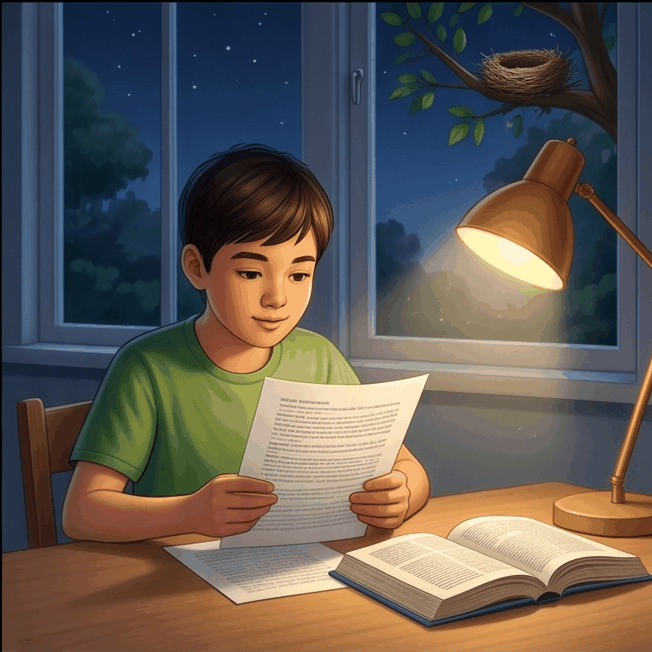
Language Pattern: Talking About Frequency
Always and Often
always = every time
often = many times
Pattern:
Subject + always/often + verb
Examples:
- I always read before bed.
- We often run in the park.
- She always helps me.
Language Pattern: Talking About Possibility
Might
Use might when you are not sure.
Pattern:
Subject + might + verb
- It might rain.
- Someone might come later.
- I might see my friend tonight.
Worked Example 1
Sentence: I always read a text at night.
Step 1: Find the frequency word → always.
Step 2: Find the action → read.
Step 3: Find the time → at night.
Meaning: I read every night.
Worked Example 2
Sentence: This paper is mine.
mine means it belongs to me.
Question: Whose paper is it?
Answer: It is my paper.
Worked Example 3
Sentence: The door is closed, but I might open it.
closed = not open.
might = maybe.
open = make the door not closed.
Meaning: The door is shut now, but maybe I will open it.
Unit Summary
- Use always and often to talk about frequency.
- Use might to talk about possibility.
- Learn words about people, things, actions, and daily life.
- Remember the difference between open and closed.
- Practice using new words in short everyday sentences.
🔑 Đáp án & Giải thích
always = luôn luôn, diễn tả việc xảy ra mọi lúc.
often = thường xuyên, xảy ra nhiều lần.
might = có thể, dùng khi chưa chắc chắn.
open = mở; closed = đóng.
mine = của tôi.
someone = ai đó; something = cái gì đó.
Ví dụ: "I always read at night." nghĩa là "Tôi luôn đọc sách vào buổi tối".
Ví dụ: "It might rain." nghĩa là "Trời có thể sẽ mưa".