Unit 10 Theory Page
Unit Goal
In this unit, you will learn high-frequency words about places, movement, nature, numbers, and daily activities. You will read and understand simple sentences with these common words.
Target Vocabulary
Actions
- go = move to another place
- run = move fast with your feet
- walk = move slowly on your feet
- took = past form of take
- ran = past form of run
- began = past form of begin
- grow = become bigger
- mop = clean the floor
- offer = give or present something
- got = received or had
People and Groups
- group = several people together
- children = young people; kids
- tot = a very young child
Places and Nature
- tent = a shelter made of cloth
- car = a road vehicle
- port = a place where ships stop
- sea = a large body of salt water
- river = water that flows across land
- grass = green plants on the ground
- side = one part of something
- import = bring goods from another country
Time and Frequency
- often = many times
- night = the dark time after sunset
- until = up to a time
- off = not on; away from
Numbers and Measurement
- ten = number 10
- four = number 4
- mile = a unit of distance
- feet = plural of foot
Other Useful Words
- important = very useful or necessary
- not = used to make a negative sentence
- soup = a liquid food
- white = a color
- fun = enjoyable
- fan = a machine that moves air
Picture Vocabulary
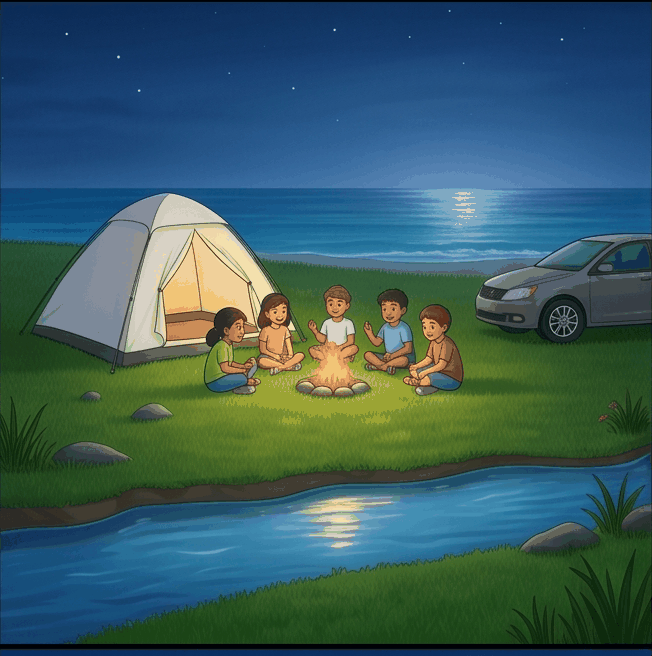
Look at the picture and find these words:
- tent
- children
- river
- grass
- car
- night
- white
Useful Language Patterns
Talking About Habits
Subject + often + verb
We use often to talk about things that happen many times.
Example: I often walk by the river.
Example: The children often run on the grass.
Talking About the Past
Some verbs change in the past.
- run → ran
- begin → began
- take → took
- get → got
Example: The children ran to the tent.
Example: We took soup to the group.
Negative Sentences with "not"
Subject + be/verb + not
Example: The car is not white.
Example: We do not go to the port at night.
Worked Examples
Example 1
Sentence: The children often run on the grass.
Meaning: The children do this many times.
Key word: often = many times.
Example 2
Sentence: We ran one mile to the river.
Meaning: The action happened in the past.
Key word: ran = past form of run.
Example 3
Sentence: The group stayed in the tent until night.
Meaning: They stayed there up to the time of night.
Key word: until = up to a time.
Remember!
- Use often for habits.
- Learn past forms: got, took, ran, began.
- Use not to make a sentence negative.
- Practice place words: river, sea, port, tent.
- Practice movement words: go, walk, run.
🔑 Đáp án & Giải thích
Ghi nhớ từ vựng:
- often = thường xuyên.
- ran là quá khứ của run.
- began là quá khứ của begin.
- took là quá khứ của take.
- got là quá khứ của get.
- until có nghĩa là "cho đến khi".
- not dùng để tạo câu phủ định.
Ví dụ: "The children ran to the tent." nghĩa là "Những đứa trẻ đã chạy đến cái lều." Hành động xảy ra trong quá khứ nên dùng ran.